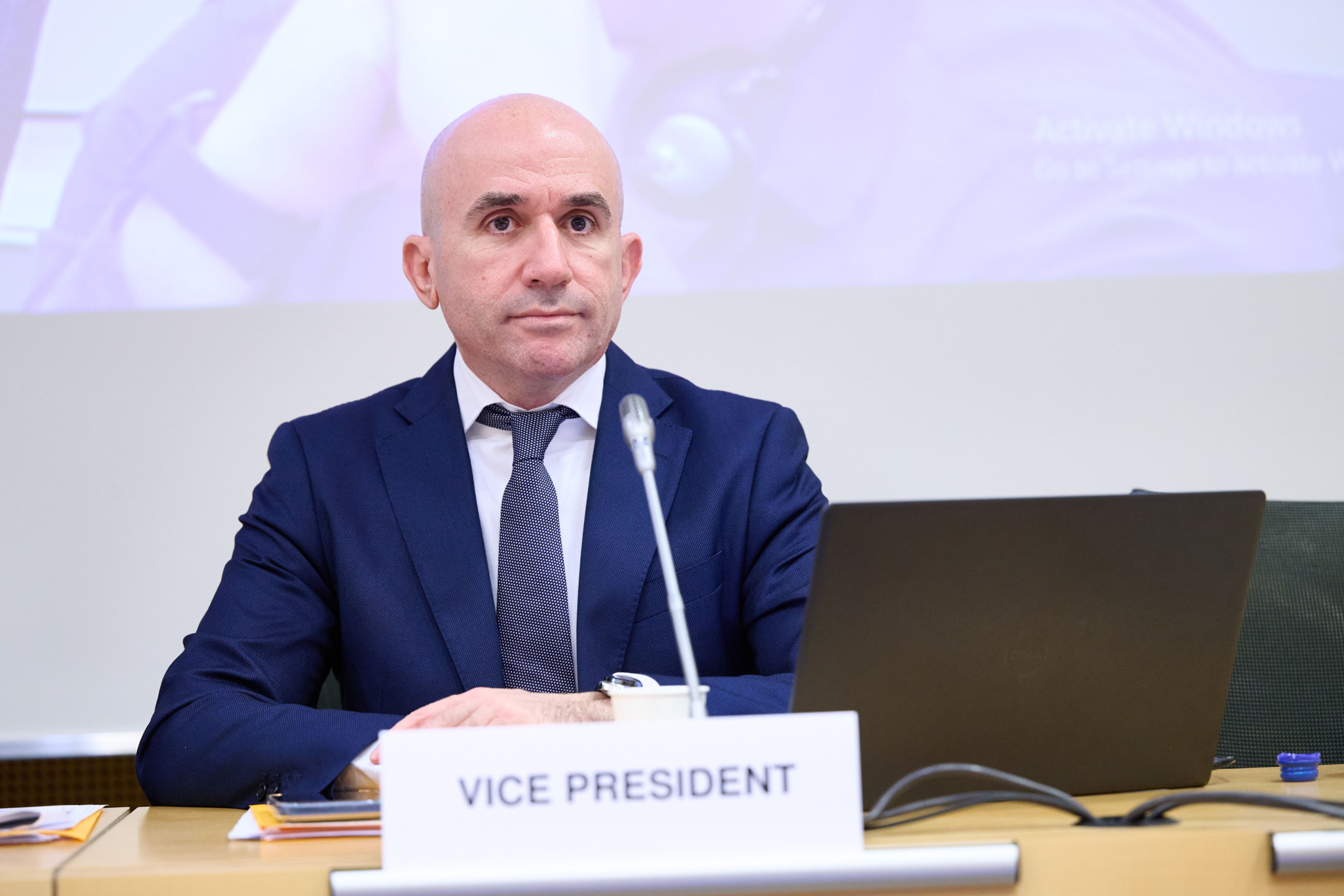
ATHENS. Dr Grigoris Leon speaks to the National Herald (“Ethnikos Kirikas”) about his academic path, his family, and how he experienced the death of his father not as a forensic pathologist but as a son.
Dr Leon is married to Dimitra, a journalist, and they have a 15-year-old son. As he confides, last November brought the first very great loss in his family: that of his father. It affected him deeply on a personal level, as it was the first time he had experienced death so close to him.
National Herald: You have studied very extensively. Why?
Dr Grigoris Leon: Indeed, I have followed a fairly long academic path: three master’s degrees, a doctorate, continuous postgraduate training and part of my training in the United States. The reason is very simple. I wanted to delve as deeply as possible into the science I chose to serve, so that I could practise it in the best possible way.

Dr Grigoris Leon with Prof. Santo Davide Ferrara, then President of the International Academy of Legal Medicine (IALM) and Professor of Legal Medicine and Forensic Toxicology at the University of Padua, 2015.
In Medicine, however, education never ends. I won’t hide from you that even today, many evenings when I am at home, I still read and learn. I try to follow new scientific evidence and to stay constantly informed about anything new.
Fortunately, Medicine is a science that is constantly evolving. That is what makes it so interesting. You can never say “I’ve learnt it all”. You must constantly follow knowledge and new developments. And to be able to do that throughout your life, you really have to love what you do.
N.H.: What are the differences between a forensic pathologist working in Greece and one working in America?
Dr Grigoris Leon: The differences are very great. In the United States I had the opportunity to train at the Broward County Medical Examiner’s Office in Florida. There, the forensic pathologist works within an essentially autonomous service that has its own investigators, specialised staff, laboratories and a whole mechanism supporting the investigation of a death. The main task of the forensic pathologist in the United States is chiefly the investigation of sudden, violent or suspicious deaths.
In Greece we follow more the European model of Legal Medicine, in which the forensic pathologist has a much broader role. They do not deal only with the dead.
And, of course, there is also the big difference in pay. But this does not concern only Forensic Medicine. In general, in the United States the pay of many specialised professions is at a different level.

Dr Grigoris Leon with His All-Holiness Ecumenical Patriarch Bartholomew, at the Ecumenical Patriarchate in the Phanar, Constantinople.
N.H.: Guns and deaths in America. What is the connection?
Dr Grigoris Leon: From my own experience in the United States, what made a very great impression on me was how often we came across deaths from firearms.
I clearly remember that in Broward County, out of the roughly five autopsies I could perform in a day, there were days when two of them involved firearm cases. For a Greek forensic pathologist, this is a very different picture from the one usually encountered in Greece.
When access to guns is easier in a society and a gun may be readily available inside a home, the occasions on which it may be used also increase: in a homicide, a suicide, an accident or even in a moment of intense conflict.
Fortunately, in Greece we do not have the same daily experience with firearms. And I think this is something we must protect.
N.H.: “Sellers of vanity, managers of hope.” What is wrong with the system?
Dr Grigoris Leon: Unfortunately, there are also doctors who forget that Medicine has rules, scientific limits and, above all, ethics.

Dr Grigoris Leon with Dr Thomas T. Noguchi, President of the World Association for Medical Law (WAML) and former Chief Medical Examiner of Los Angeles County, at the 24th World Congress on Medical Law, 2018.
There are some who may exploit a healthy person’s desire to become more beautiful, stay young or live longer. And there are people going through a difficult moment in their lives who are ready to believe anyone who promises them hope.
That, for me, is the red line.
A doctor can be neither a seller of vanity nor a merchant of hope.
The white coat brings enormous responsibility to the person who wears it, because the person in front of you believes that what you propose is based on science and entrusts their health to your hands.
Of course, when we refer to a specific case that is under judicial investigation, we must be careful about attributing specific responsibility. But there is a general principle that for me is non-negotiable: no treatment becomes scientifically acceptable simply because it is carried out in a doctor’s office or because it is proposed by someone wearing a white coat.

Dr Grigoris Leon with the President of the World Anti-Doping Agency (WADA), Witold Bańka, in the context of international cooperation to protect clean sport. 2025
N.H.: Apparent death: what are its consequences? Who can really diagnose whether a person is dead?
Dr Grigoris Leon: In the past, cases have been described of people who were initially declared dead when in reality death had not occurred.
This is how many stories of “apparent death” came about: people who remained somewhere as if dead, or even cases where a person was thought to have “come back to life”.
In reality, they had not been resurrected. Death had simply not been properly established.
In Greece, in fact, the institutional framework in the past allowed, under certain conditions, even non-doctors to be involved in certifying a death. And this obviously created problems.
With the establishment of medical certification of death and specific scientific procedures, the situation changed substantially.
N.H.: What exactly does the profession of forensic pathologist involve?
Dr Grigoris Leon: The profession of forensic pathologist in Greece has an extremely broad scope. It deals with homicides and criminal acts in general, suicides, sexual violence, beatings, domestic violence, road and occupational accidents, medical liability and many other matters in which medical knowledge is needed to answer a legal or judicial question.

Broward County Medical Examiner’s Office, Florida — Dr Grigoris Leon with Chief Medical Examiner Dr Joshua Perper, Deputy Chief Medical Examiner Dr Stephen J. Cina and Chief Toxicologist Dr Harold E. Schueler, on completing his postgraduate training in Forensic Medicine. 2009
So it is not — as people often believe — simply “the doctor who does autopsies”. The scope is much broader and concerns both the dead and the living. Precisely because the field is so extensive, correspondingly extensive training is required. That is why the specialty in Greece lasts five years.
N.H.: How hard is such frequent contact with the dead?
Dr Grigoris Leon: I fully understand how a forensic pathologist’s daily contact with the dead looks to someone who has nothing to do with Medicine.
But we must remember that a forensic pathologist does not suddenly find themselves, one day, in front of an autopsy table.
We are doctors first. Already during our studies we have come into contact with the human body, we have been in operating theatres, we have seen serious cases and we have experienced people dying in front of us. Then, during our specialisation in Forensic Medicine, contact with death becomes part of everyday life. So, gradually, you learn that your relationship with each case must be strictly professional.
The forensic pathologist must not allow emotion to influence their scientific judgement. Even when faced with relatives at an extremely difficult moment, they must listen, understand and respect their pain, while at the same time remaining objective.
Because once you allow emotion — or any other external factor — to influence your judgement, the risk of reaching a wrong scientific conclusion increases.
N.H.: Has your profession changed your outlook on life?
Dr Grigoris Leon: When you see every day how easily and how suddenly a human life can be lost, you realise that life itself is the supreme good. And that we must live it as much and as well as we can.
I have learnt to smile more, to enjoy myself more and to try to savour even the small moments of everyday life.
I don’t want to waste my life on pointless things, petty disputes or things that ultimately do not really matter.
So if Forensic Medicine has taught me anything, it is to be glad to be alive.